Welcome to Health Unscripted, brought to you by Evernorth, a podcast featuring real, raw conversations with some of the most knowledgeable experts in the health care industry.
Ashley Holzworth-Nash
Welcome to the Health Unscripted podcast. My name is Ashley Holzworth-Nash, and I'm the head of product here at Evernorth on our PBS Strategy and Solutions team. I am so excited by the work we continue to do with our community pharmacists, making sure that those pillars of our community are able to do more than just dispense prescriptions for our members.
I'm a pharmacist by training. My heart is always anchored in all that pharmacists can do. So, I am extremely honored and excited to sit down here today with Duane Jones. He's been a pharmacist for over 40 years, and he's a key member of our Independent Pharmacy Advisory Council. And, if I say, a dear friend from getting to know him over the last several years and working more in this space. Before we jump into today and really talk more about what pharmacists can do for all of our members, Duane, can you tell the audience just a little bit about yourself?
Duane Jones
Well, absolutely. Thank you very much for this opportunity, Ashley. It's been a joy working with you. It's been a joy being on the Independent Pharmacy Advisory Council. And I've been, like you said, a pharmacist for 40 years plus. I've seen a lot of changes in this profession in the last 40 years. My heart has always been on the clinical side of pharmacy, owning my own pharmacies.
Like I said, being part of IPAC has just been icing on the cake for me. I also sit on advisory councils for other organizations, on the Dean's Advisory Council for the University of Arkansas College of Pharmacy. I'm on the board of directors for the Arkansas Pharmacy Association and sit on a care coalition council trying to make sure that we help people understand the value of pharmacy in community today, as you said, beyond dispensing and actually impacting patient outcomes and patient care.
Ashley Holzworth-Nash
So, in 40 years, I'm sure you have seen many changes in our profession, in the community pharmacy, working with patients, and really just how even pharmacists are viewed. It's been a long, fun journey that you have been on. And so, I want to talk a little more about that journey today. So, can you tell me a little bit more about why pharmacists have really become critical partners in enabling patient care and enabling the access to patient care?
Duane Jones
So, as we have seen the landscape of health care change over the years… In my tenure, I've seen it go from your primary care physician took care of almost all of your medical needs into a specialized field where you are now seeing specialists for everything that you're doing. Well, that created a major issue, because now, who's monitoring those prescriptions that are coming from all these different sources?
Well, pharmacy has been that key guardian in the community in regards to that. So, as we saw, curriculum in pharmacy schools change to address that, pharmacists have become increasingly specialist in medication therapy management out of necessity, because we're the only profession that sees all the different medications that are prescribed for these patients.
So, we're going to lose 40% of our PCPs in the next ten years. For everybody in this country to have equal access to care, we need 200,000 providers today.
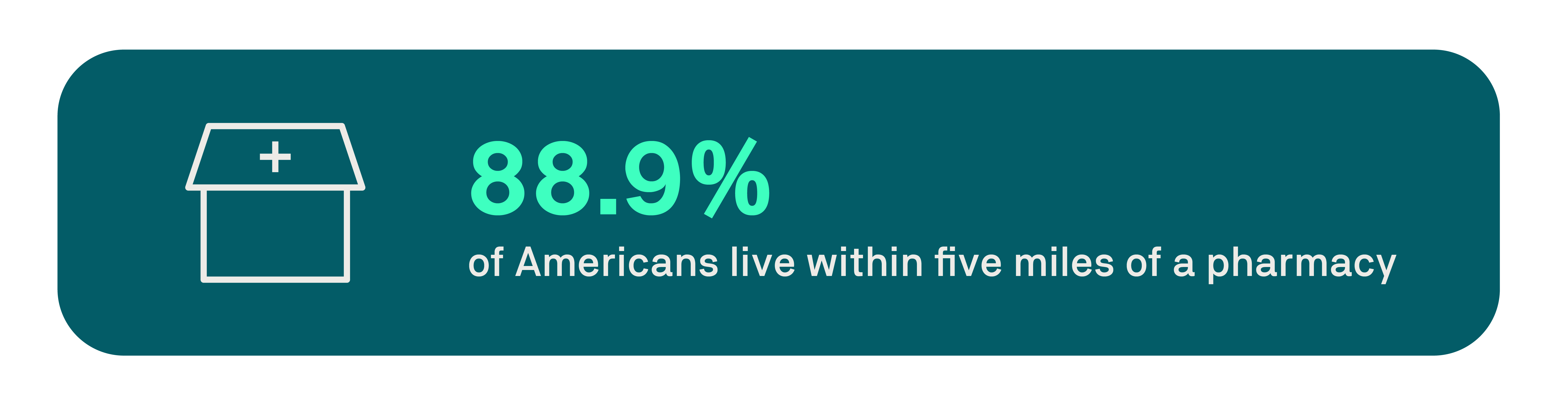
Well, that's not possible if we're going to lose 40% of them. However, there is a pharmacy within five miles of 90% of the population. So, one of the questions comes up is, well, are pharmacists really qualified to do this? Well, yes. If you look at PAs and advanced nurse practitioners that have prescriptive authority, pharmacists have an average of two years more education post-undergrad than they do.
And it's specialized in medication therapy management. So yes, we are qualified. We are accessible. We’re the solution. So, what we have to do is help people understand that we don't just put pills in a bottle. We actually look at situations to avoid adverse effects.
Ashley Holzworth-Nash
Duane, I think you've hit the nail on the head. I think there is more of a need and there is less of an availability to access the care. But to your point, there's pharmacies and pharmacists available in every community who can fill these vital gaps for our patients to make sure that they are being monitored, they are receiving the appropriate care.
And it's a lot of those lower-acuity, right, those lower-triage type issues that pharmacists can handle, but they also know how to handle patients that they do see that need more higher intensity and help them get to the physicians because they are pillars of their community and they do have access to resources, right, to help the patients, depending on the state in which the patient is being viewed by that pharmacist.
Can we talk a little bit about the trust of a pharmacist and a patient from a relationship perspective? We're both pharmacists, obviously, but as we have seen, pharmacists continue to be one of the most, if not the most, trusted visit or practitioner when it comes to working with our patients. They do see their pharmacists frequently. They talk to them when they come into their communities.
Can you talk a little bit about just the trust that you see between patients and pharmacists that will help them go beyond the act of dispensing and actually be more involved in the patient's care?
Duane Jones
Well, that's very true, Ashley. We see a patient twice as often as the prescriber sees them. As a matter of fact, the studies that we've seen is, we'll see the patient 30 times a year as opposed to a physician seeing them three. That's not always to pick up their medication. They may be coming in to pick up a family member’s medication. They also come in to ask us about over-the-counter medications. So, we see them very frequently. So, we have that relationship and that trust with them. And you're right. Over the last two decades, we have consistently been the most respected and trusted health care professional ranked in this country, and that's because of the relationship we have with the patients.
I can think… I'll give you an example, a real life example. And this is really dear to my heart, because when we first started medication therapy management and insurance companies were paying us to sit down with patients, one of the first patients I sat down with was a gentleman that I had a relationship with. A diabetic. He was overweight. I had an opportunity as an insurance company paid me to sit down and do a comprehensive medication review.
I looked at his medication. He's on inappropriate medication. So we were able to change his medication to a safe sleep medication, and I had the opportunity to talk to him. I said, “Listen, you're going to have to start exercising.” So we started to talk about lifestyle changes.
Six weeks later, I see him and he goes, “Duane, thank you.” He goes, “This literally has changed my life.” He said, “I realize now that I want to be able to live long enough to see my granddaughter graduate, and I'm going to have to take care of myself.”
But he said, more importantly, “I feel better.” So, you develop that trust. Now, anytime he has a question about his diabetes, about his lifestyle, he feels really comfortable coming in to talk to us about that. So, we have those type of relationships where we can have those open conversations. What that means in the marketplace is that if I can talk to you about your lifestyle, and I can get you off of some of your medication, and I can make you healthier…
This equation is not complicated, Ashley. The healthier the patient, the lower the health care cost. And we're in that equation to be able to affect that.
Ashley Holzworth-Nash
I think you bring up such an important part that the journey of a patient is not just the pills in the bottle or the package of medication coming to their household. It's really the whole journey. And you see the patient in multiple instances. You understand their lifestyle. You understand the community that they're living in, right? To be able to help them a lot more and relate to them as… yes, as a clinician, but also as someone who just understands and sees them and is able to relate to the health care journey that they're on and help them through that entire journey. So, I think that's phenomenal. And I love that example, Duane, that you shared with me today.
I want to pivot a little bit, right. Everything that we start to talk about starts to talk about more services in a pharmacy. And that's different than the act of dispensing the medication to the patient. And so, I know a lot of clients, when we talk to them, think through, “Well, what does that mean from a total spend perspective? If there's going to be more care in a pharmacy, is that an ‘and’? Do I have to think about a higher budget when I think through the services that can be provided in these now settings for these patients?” I work with health plans very frequently. This is always a comment that I had received. How do we think about that pharmacist-led care and those medication interventions for our patients?
But what I really want to ask you is, how do you, as a pharmacist or pharmacist that are working with our patients, know when additional support is needed and when it's not? And how do we think about that care versus cost kind of balance?
Duane Jones
I understand that. And I get that question a lot and understand why they think that. Because typically when you think of pharmacy, you think of dispensing. And that's a cost factor that's going to increase. But the reality is that, if we need 200,000 more prescribers, if they came in to the communities, you'd be happy to pay them.
We're already there.
So, the patients, when they come in, say they're coming in for a strep test, they have to meet a center score, meaning that that center score indicates whether or not they have a viral or a bacterial infection. If they don't meet that score, we don't test them. If they do meet the score, then we test them.
If they're positive, we have a protocol, so we only dispense what they need. And I really like to utilize those studies, Ashley, to show that these are facts.
This is not opinions about what we think can happen in the marketplace. These are facts about actual outcomes that we've seen. So, one of the studies was about sore throat and about the center score and following their protocol. When pharmacists were involved in this, and we actually assessed the patient, only 27% of those patients actually received an antibiotic.
Now if you remove the center score, you remove the protocol from that, and you're just going to dose them based upon your clinical observation, the number of antibiotics increases to 62%. So, there's another study that that we saw last year, that 52% of all antivirals that were dispensed last year in this country were written empirically, meaning that the patient had never been tested. Of those, only 27% tested positive. So, we're setting ourselves up for a future problem with resistant strains of bacteria with the current model. Whenever they come to the pharmacy, the pharmacy follows a protocol with every single patient. So, if you look at the outcomes of this one study, we prevented unnecessary antibiotics in 47 out of 100 patients in that study.
There was another study that was done, and it was a Welsh National Pharmacy study that was done, with 11,000 patients. 11,000 of those patients received a rapid strep test. We did a center score. We got 8,600 of them. We did a strep test. Only 2,400 of those patients actually received antibiotics. That's 21%. Okay. Of all of those patients, 91% of them were effectively treated in the pharmacy. 9% were referred on to a PCP because they had symptoms that were more severe.
That's one thing I think that is missing in the marketplace. We also are able to assess that patient and determine, based upon this protocol, if they should be referred on for advanced care. Less than 1% of these people will ever reach the emergency room. This is really important whenever I say that, only 0.2% actually went to an emergency room, because I had a patient who came in to me, she brought in her two daughters.
She goes, “I can't get in to see my doctor for two weeks. Can you test them?” I said, “Yes, we can test them.” They were both sick, they were both positive, we treated them. She said, “I'm so thankful that you all are here, because I was headed to the emergency room.” That drives up health care costs. We were there. She went back and she told her doctor, she goes, “Listen. I was there, they took care of me.” We get referrals now from him during cough and cold season. Because you can't get in to see your physician in a timely manner, or, if you're going to urgent care, you're going to sit there with other sick people. So, we provide this opportunity to provide care and access to care and quality care based around a protocol that has proven outcomes and predictable outcomes.
So that's one of the keys to the success of pharmacy in the midst of this equation. So, your health care costs are not going to go up. It's the antithesis of the model today. The model today is that cost is driven by utilization of health care. It's a converse so that if you utilize pharmacists. Utilizing pharmacists for care, your savings are utilization driven based upon protocols and patients actually having access to care.
Because if they can't see us and they're going to the emergency room to get the same outcomes, your cost is exponentially greater for that than it is for the pharmacists. Because we have a limited number of CPT codes we bill, we have limited procedures that we're going to follow. And so, your savings are driven by utilization into the pharmacy.
So that's what I tell people all the time. If you think that your cost is going to go up, it's the converse of that. The healthier the patient, the lower health care costs. As pharmacists, what we are really excited about is that if we get compensated to do this with all of our patients… We're happy that we have a healthier patient, because that's the relationship we have in the community with that person that we have coming back in time and time again, and we want them to be successful in the marketplace.
Ashley Holzworth-Nash
Duane, thank you. And I love all the facts and the stats that you always bring to our conversations. Just really showcasing truly what this relationship with the pharmacist in the community and the patients can really yield when we think about it. Yes, there's utilization aspect, but it's utilization in the right setting, done the right way under protocols so that we are assured that the right testing, the right treatments, those are really taking place. And to that point, going back to what you said earlier, we have a lot of members, a lot of patients who don't have access to care, or they will go to an E.R., or they will go to an urgent care setting, or they are not going to get treated and have complications down the road depending on the disease state that we're talking about. But they can go to their pharmacy, and we have the vast majority of patients within just miles of a pharmacy who can do more of this testing. So, to your point, there may be utilization in those pharmacies, but to the greater health care ecosystem and to those members, we're actually helping to kind of bring down that total cost and what we're spending in totality around those patients where a lot of the conditions that pharmacists in our community settings can really influence.
So, I want to think a little bit about the employer side now, and hearing about paying for the services as you started to talk about. So, when you think about that immediate expense, we don't necessarily always see the downstream savings. You start to talk a little bit about that, especially in the test-to-treat type spaces. We talked about the utilization, but I want to talk a little bit more about how we think about the value.
How do we help employers think about the total value that pharmacies are driving by doing these additional types of services?
Duane Jones
As we look at these individual services that we provide, and we've done studies. We did a study with the CDC and our Department of Health, and we taught 18 pharmacies in a rural area, the most underserved area of Arkansas, how to work with these patients with diabetes and hypertension and teach them how to manage their disease state.
And it was an extremely successful program. The last year I went to the legislative review to get funding, and they said, “Well, this doesn't look good, Duane, because you had three people that fell out of this program.” I said, “Well, they fell out of the program because we taught them how to manage their disease state. They're no longer on medication. And so, you have to be on medication to be in the study.”
So, I share that to say that segues right into an article that was done in JAMA, the Journal of American Medical Association, in 2023. And this article was centered around paying pharmacists to prescribe antihypertensive medications for people with high blood pressure. The study revealed that if you only have a 50% uptake of the patients in this program, you'll save $1.3 trillion over 30 years. That's $10,000 per patient over 30 years.
Also, the same study shows that you also save 30 million life years. That's only if you have a 50% uptake into this program. And that's a JAMA study that's published. So, when you look at the total cost of savings, the total cost of savings on your total health care spend is going to be huge.
The other thing that we overlook oftentimes, Ashley, is that if you're talking about an employer, sick time costs corporate America $65 billion a year. Now I've got a healthier worker that also impacts that $65 billion cost every year. And it can be argued at some point that those are soft dollars, but those soft dollars become hard dollars within the fiscal year.
It's still a savings. It's still healthier people. You still have a total health care cost savings. So, your total savings cost is going to be great. It's going to be like we've talked about in the past. There's going to come that juncture in time when the plans are going to say the people that are getting on board, that are seeing the value now, it's going to be, “This is amazing. Why have we never done this before? Why have we not pursued this before?” Well, the marketplace has never led you to this. This data has been here for a long time. Why haven't we shared this data? Why haven't we had this opportunity, you and I, to share this data? Because the marketplace didn't want the information. Now that we have a marketplace that is broken, that we have 40% of our budget in this country is health care, that's not sustainable, we have to find a solution. Well, the solution is pretty simple: Going back and putting patients back at the center of patient care. Letting pharmacists who are within five miles of 90% of the population, that have the education, that have the knowledge, that have the protocol-driven therapy to actually operate the top of their education and fill this gap and fill this lack-of-care gap.
And once we do that, then you start to impact the cost of care. How does that look like for payers and for us and for the plans? Now you look at a value-based program. And so now you look at savings on the plan. And how much savings I can share with you is how much we can generate. We generate it for the plan, we generate it for the employer. Ultimately, we generate it for the patient.
And I've got so many stories of patients that have come in, that we've taken care of, and they're like, “This is amazing. I can come here. I get this service. I'm not sitting in a crowded waiting room. And I go home and tell my friends, ‘This is where you need to go.’”
One of the challenges is getting all of our members within the plans to realize that these services are available. The great thing about IPAC, and the great thing about working with Evernorth, is we're solving that problem. We're generating that information out, and we're creating that knowledge base for the plans to make intelligent decisions.
Ashley Holzworth-Nash
You have a great history that you've grown from to really showcase what pharmacists can do in the community and where we sit today. We've come a long way to get to where we are, but it's prepared us for the future.
So, if you take out your proverbial crystal ball, Duane, where do you see the future of care going for patients, and how does that look for employers as well? How do you see pharmacists being that critical partner into the future in advancing the care?
Duane Jones
I see us as a destination point for care on multiple levels. I go back to the payer summit that I was in, and the chief medical officer said, “I can't wait to send you my diabetic and my hypertensive patients.” We have done those studies. We have that trust with those people. I talk to companies, I’ve talked to large entities, chains that are saying, “We're implementing technology to free up our pharmacists to be able to do more clinical services.”
And so, whenever we assess the patient, we're assessing them based upon evidence-based medication, because we have to, by law, follow this protocol. It's all about making the patient better and making sure the patient is taken care of.
So, if we can provide oral contraceptive therapy, if we can do A1Cs for patients, if we can do UTI exams, if we can do strep and flu testing, if we can assess your diabetic and your hypertensive patient, there's your access to care. There's your solution for the health care of the future. That's keeping them out of the expensive… I mean, I know that they're going to go to the emergency room if they can't get access to care. But the sad thing is, so many people will avoid care, and they ultimately wind up in the hospital with a more severe situation. So, I see us in the future being that solution. And like I said, there's going to be that “Aha” moment and there's going to be that time that people are going to say, “Why have we never done this before?”
Well, the marketplace didn't lend itself to it, number one. Number two, there's such a necessity now and such a shortage of providers that we are the solution for that. And with the knowledge base we have, with the education we have, with the protocols that we have, everybody follows the same. So, everybody is going to get the same level of care based upon the protocols.
The future is going to be pharmacy as an access point for care.
But more importantly, we're providing patients with knowledge, education, and a healthier lifestyle.
Ashley Holzworth-Nash
I think that the future… it’s bright. I have a little one. I see her having a future that is robust with pharmacists in her community, being able to help her through her lifestyle journey. Also being able to continue to service all the areas, of rural and remote and even in our urban deserts, when even a pharmacy might be a few miles away.
So, Duane, thank you for everything that you do for your community and also for the pharmacist community to help us change, really, how we're thinking about pharmacists and seeing them as being pillars who can provide additional services and close a lot of gaps in care and help the entire health care ecosystem bring down dollars in a world where we know affordability is a crisis, and we know that care is critical to our patients. And we need to really merge the two so that we can afford that critical care into the future and be able to have healthier patients at the outturn of all of that.
So, Duane, thank you for being on our podcast today. And I look forward to future conversations.
Thank you for listening to this episode of Health Unscripted, brought to you by Evernorth. If you enjoyed today's show, please take a moment to subscribe wherever you get your podcasts.